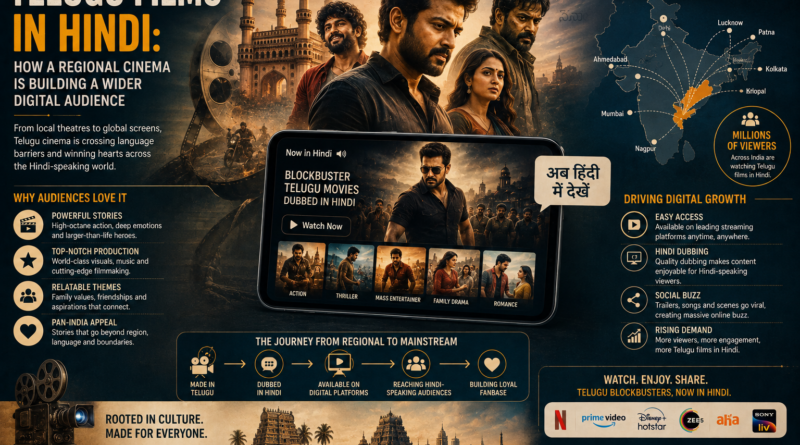
How a Regional Cinema Is Building a Wider Digital Audience
Telugu cinema has become one of the most prominent regional film industries in India, with a domestic market that increasingly connects to audiences across the country and abroad. The expansion of streaming and language localization has played an important role in that transition. Hindi dubbing, in particular, gives viewers who do not speak Telugu a straightforward way to explore the industry’s diverse catalog. For audiences searching for तेलुगू फिल्में हिंदी में, digital access creates a bridge between Telugu filmmaking and a much broader Hindi-speaking audience.
Telugu Cinema Has Become a National Entertainment Force
The importance of Telugu filmmaking extends well beyond Andhra Pradesh and Telangana. During the 2024 financial year, Telugu-language films represented approximately 20% of India’s total box-office collections, according to a Ministry of Information and Broadcasting industry report. The same analysis showed Telugu cinema increasing its share from 15% in FY2020 to 20% in FY2024.
These figures illustrate how regional cinema has become increasingly significant within India’s national film market. Telugu productions are no longer primarily relevant to audiences who speak the language. Their scale, production values, genres, and growing digital availability have created interest among viewers throughout the country.
For Hindi-speaking audiences, localization provides an important entry point. Instead of requiring prior knowledge of Telugu, Hindi dubbing allows viewers to experience regional cinema through a familiar language while retaining its original cultural environment.
Hindi Dubbing Opens the Door to a New Audience
Language remains one of the most important factors determining whether an audience can comfortably engage with regional entertainment. Subtitles provide an effective solution, but Hindi dubbing offers a different kind of accessibility.
With Hindi audio, viewers can follow dialogue naturally without continuously reading text. This can be especially convenient for longer viewing sessions, family entertainment, and audiences who simply prefer consuming movies in Hindi.
The growing importance of localized cinema is reflected in India’s broader film-distribution framework. The Ministry of Information and Broadcasting has specifically addressed the certification of Hindi-dubbed versions of films, indicating that localized releases have become a recognized component of the national film industry.
For Telugu cinema, this creates a practical opportunity to reach audiences in regions where the original language is not commonly spoken.
The Telugu Catalog Is More Diverse Than Its Reputation Suggests
Internationally, Telugu cinema is often associated with large-scale commercial productions, but the industry encompasses a much wider range of genres. Drama, comedy, romance, thriller, crime, family entertainment, fantasy, historical subjects, social cinema, and action all contribute to its contemporary catalog.
This diversity becomes particularly useful when Telugu films are presented through an online Hindi-language catalog. Viewers can approach the industry through familiar genres rather than needing prior knowledge of its filmmaking traditions.
Someone interested in suspense can explore that category, while another viewer may prefer comedy, family entertainment, or romance. A well-organized digital catalog makes these distinctions visible.
Over time, this can encourage audiences to move beyond the most widely recognized Telugu titles and discover the breadth of the regional industry.
Streaming Is Removing Geographic Boundaries
The traditional distribution of regional cinema depended heavily on local theaters, television networks, and physical media. A Telugu production could be widely available in Hyderabad or Vijayawada while receiving little exposure in other parts of India.
Digital distribution has changed that equation. Online catalogs can make regional-language films available to audiences regardless of whether a nearby cinema or television channel regularly carries Telugu entertainment.
India’s OTT ecosystem has expanded rapidly, with official government data documenting a large and increasingly diverse collection of online curated-content platforms.
This matters for Telugu cinema because its audience is now geographically distributed. Viewers in Mumbai, Delhi, Bengaluru, Dubai, London, Toronto, or Singapore can potentially discover the same regional entertainment through connected devices.
The digital environment therefore allows Telugu cinema to maintain its linguistic identity while reaching beyond its original territory.
The Digital Catalog Is Part of the Discovery Process
A large collection is useful only when viewers can navigate it efficiently. This is particularly true for audiences who are discovering Telugu cinema through Hindi rather than through the original language.
Clear language information, genre categories, curated collections, search functionality, and recently added sections can provide different routes through the catalog. Viewers with a specific title in mind can search directly, while newcomers can browse by genre or collection.
This creates a more active form of movie discovery. Instead of waiting for a television channel to decide what becomes available, the audience determines the direction of exploration.
The catalog can also encourage cross-cultural discovery. Someone who begins with a Hindi-dubbed Telugu film may become interested in other South Indian industries or additional regional categories, gradually developing a broader understanding of Indian cinema.
A Frictionless Route From Selection to Viewing
The convenience of digital cinema depends heavily on what happens after a viewer finds something interesting. Registration walls, unnecessary redirects, and intrusive pop-ups can undermine the advantages of online access.
Moviewala’s Hindi catalog focuses on keeping this journey direct. Viewers can browse the available Telugu selection, choose a title from the digital shelf, and move toward playback without a mandatory sign-up process. The absence of annoying pop-ups also keeps the interface focused on discovery rather than interruption.
This is especially useful when exploring unfamiliar regional cinema. A viewer can investigate one title, return to the catalog, compare another category, and continue browsing without repeatedly encountering administrative barriers.
One-click access reduces the distance between curiosity and playback, allowing the catalog to function as a straightforward digital shelf.
Telugu Cinema Across Modern Viewing Devices
The growth of streaming has made the viewing environment increasingly flexible. Smart TVs provide a large-screen experience for home entertainment, while laptops and desktop computers remain useful for individual sessions. Smartphones and tablets provide access when viewers are away from a television.
This flexibility is particularly valuable for audiences outside Telugu-speaking regions. A person may not have access to a Telugu television channel but can still explore a Hindi-dubbed Telugu catalog through a connected device.
Responsive design is therefore essential. The same content should remain easy to identify and navigate whether it appears on a large television, laptop, tablet, or smartphone.
The interface can adapt to the screen without changing the basic viewing journey. The viewer selects a category, chooses a title, and begins playback in essentially the same way.
What Happens Behind the Play Button
Delivering a high-quality Telugu film with Hindi audio requires a substantial digital infrastructure. Streaming systems must handle large video files, localized audio tracks, subtitles, metadata, different screen resolutions, and varying network conditions.
Efficient video compression reduces the amount of data needed for transmission, while adaptive streaming can adjust video quality when bandwidth changes. Cloud infrastructure and content delivery networks help distribute media across different regions.
The multilingual element adds another layer. A film may have its original Telugu soundtrack alongside a Hindi version and potentially additional language options. The platform needs to organize those components without making the viewer’s interface complicated.
The best technical experience is almost invisible. Viewers should simply select the Hindi version, start the film, and receive stable, high-quality playback.
Telugu Cinema Has a Strong International Dimension
The global reach of Telugu cinema is closely connected with the international distribution of Indian entertainment. Telugu-speaking communities are established across the Gulf, North America, Europe, Southeast Asia, and other regions, creating a substantial audience outside India’s traditional Telugu-language markets.
Digital access strengthens this connection because audiences do not have to depend entirely on local theaters or specialist television services.
Hindi dubbing expands the potential audience even further. It creates an opportunity for viewers who have no Telugu-language background to experience the industry’s filmmaking traditions through a language they already understand.
This creates a useful combination of regional authenticity and national accessibility. Telugu remains the cultural foundation of the production, while Hindi provides a broader linguistic gateway.
Regional Cinema Is Becoming More Visible in India
The expansion of Telugu cinema is part of a larger change in how Indian audiences consume entertainment. Hindi remains an enormous category, but regional industries increasingly have their own digital identities.
Government analysis of India’s media and entertainment sector has highlighted the growing importance of regional-language content and the increasing ability of streaming platforms to reach audiences according to linguistic preferences.
For Telugu cinema, this creates an environment in which national visibility no longer requires complete linguistic assimilation. A film can remain Telugu while being presented through Hindi dubbing, English subtitles, or other language options.
This is an important development for India’s cultural landscape because it allows different film industries to grow internationally without losing the regional identities that distinguish them.
The Future of Telugu Films in Hindi
The expansion of Hindi-dubbed Telugu cinema is likely to continue as Indian streaming audiences become increasingly comfortable moving between languages. Better dubbing, improved search technology, more responsive interfaces, and increasingly sophisticated catalogs can make regional entertainment easier to discover.
The underlying market is already substantial. Telugu cinema’s growing share of India’s box office demonstrates that regional-language filmmaking has become a national commercial force, while streaming gives these productions additional opportunities to reach audiences after their theatrical exposure.
For viewers, the experience should remain uncomplicated even as the catalog grows. Open the Moviewala Hindi catalog, explore the Telugu selection, choose a title directly from the shelf, select the available Hindi version, and press play. With high-quality playback, direct one-click access, no registration wall, and no distracting pop-ups, the digital environment can remain unobtrusive while Telugu cinema reaches a broader Hindi-speaking audience.